

Modelling the economic, fiscal, and regulatory impacts of a public-health-led recreational cannabis market
What would replacing prohibition look like?
Cannabis use is not new in Victoria. Despite decades of prohibition, evidence suggests demand has remained largely steady both in volume and product type. How this demand has been met has also remained largely unchanged: consumers largely access cannabis through an illicit market that operates without product standards, consumer protections, or any contribution to public revenue.
For policymakers, this raises a persistent question: If prohibition has not eliminated use, does it still make sense to maintain it as a persistent policy? Or could a carefully designed, tightly regulated legal market better protect public health while delivering broader economic benefits?
Internationally, governments have begun to test this question. Canada and several US jurisdictions have introduced legal recreational cannabis markets anchored by strong regulation and a focus on harm minimisation.
Those experiences provided the backdrop for the Penington Institute’s engagement with Sapere:
If Victoria were the first Australian jurisdiction to legalise recreational cannabis under a conservative, public‑health‑led regulatory framework, what would this mean for government revenue, jobs, and the wider economy?
A conservative lens on a complex issue
From the outset, Sapere approached the analysis with caution. Rather than modelling a high growth or lightly regulated market, we considered what a plausible Australian policy design might look like. To this end, our modelling assumes:
- Strong regulation broadly aligned with the Canadian approach, with an explicit focus on harm minimisation
- Consideration of a single product type (dried cannabis flower only)
- Physical, in person retail sales only
- No interstate or international trade
- No cannabis tourism effects
- No allowance for construction or capital investment effects.
These constraints ultimately shaped our treatment of who enters the market, how quickly it grows, and the extent to which legal supply replaces illicit activity. Given our conservative starting point, our findings should be read as a lower bound estimate – illustrating what Victoria might expect under tight regulation, rather than an optimistic and expansive best case scenario.
The market that already exists
Before turning to the impacts of legalisation, we asked a simpler question: how large is the cannabis market in Victoria today?
Using national survey data adjusted for known under reporting and informed by evidence from jurisdictions that have already legalised, we estimated that around 135 tonnes of cannabis are consumed in Victoria each year. Importantly, this level of consumption appears relatively stable over time.
Importantly, a legal market would not be creating demand from nothing. Instead, it would bring this illicit consumption into the open over time, subjecting it to regulation, oversight and formal economic activity.
Sapere assumed an initial legal price of $12 per gram, falling gradually in real terms as regulated supply becomes more efficient. On that basis, the modelling shows a steady shift away from illicit supply:
- Around three quarters of the illegal market displaced within five years
- Up to 95% displaced within ten years.
By year ten, the legal recreational cannabis market is projected to reach around $1.54 billion per year (in real terms).
| Year following commencement of Victorian adult-use cannabis legislation | |||||||||||
| 0 | 1 | 2 | 3 | 4 | 5 | 6 | 7 | 8 | 9 | 10 | |
| Total size of legal market ($m) | – | 842 | 942 | 1,016 | 1,011 | 1,077 | 1,161 | 1,257 | 1,358 | 1,449 | 1,544 |
What regulation looks like on the ground
To translate this shift in demand into economic outcomes, Sapere modelled what a fully regulated cannabis industry would look like in practice. Based on the model used in several Canadian jurisdictions (determined to be the most applicable analogue for Victoria), Sapere assumed a supply chain that included licensed operators across:
- Cultivation
- Manufacturing
- Distribution
- Testing and compliance
- Retail
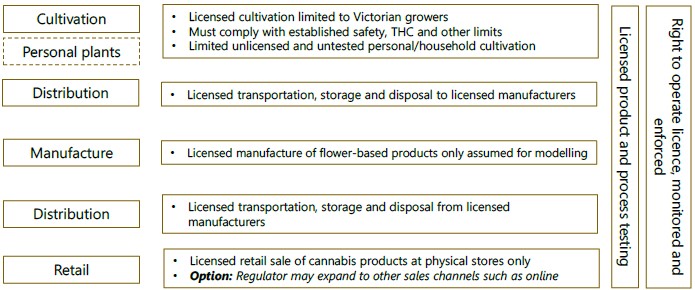
Regulation was intentionally strict, aligning with best practice settings seen internationally. We assumed products were capped at 25% THC, all had to undergo laboratory testing, and were sold with standardised labelling and plain packaging. Enforcement against unlicensed activity was assumed to continue.
What this could mean for government revenue
One of the most common concerns in cannabis reform debates is taxation. Tax too heavily and consumers stay in the black market; tax too lightly and governments leave revenue on the table. Reflecting Australia’s constitutional constraints, Sapere assumed that total cannabis specific taxes and fees-across Commonwealth and State governments-would not exceed 20% of the retail price.
Even within this conservative envelope, the revenue implications are substantial:
- Around $172 million in government revenue in the first year of legal sales
- More than $300 million per year by year ten
- Approximately $1.9 billion in additional government revenue (in net present value terms) over a decade, including payroll tax effects.
These results suggest that meaningful, sustained fiscal benefits are achievable without relying on tax settings that would undermine the transition away from illicit supply.
| Year following commencement of Victorian adult-use cannabis legislation | |||||||||||
| 1 | 2 | 3 | 4 | 5 | 6 | 7 | 8 | 9 | 10 | ||
| Maximum gov’t revenue impost (%) | 0.2 | 0.2 | 0.2 | 0.2 | 0.2 | 0.2 | 0.2 | 0.2 | 0.2 | 0.2 | |
| Maximum revenue ($m) | $172 | $193 | $208 | $207 | $221 | $238 | $258 | $278 | $297 | $316 | |
Economy wide effects beyond revenue
Government revenue is only part of the picture. Sapere also examined how a new regulated cannabis industry would interact with the broader Victorian economy. Using a detailed input–output model of the Victorian economy, the analysis captures not only direct industry activity, but also flow on effects through supply chains and household spending of a newly legalised cannabis industry.
Economic activity
The modelling indicates:
- A $1.49 billion lift in total economic output in the first year of operation
- Around $18.3 billion in cumulative economic activity over ten years.
Jobs and incomes
On average, over the ten year period, the legal market supports:
- 4,300 direct full time equivalent jobs within cannabis related industries
- 1,400 additional jobs across supply chains
- Over 7,000 jobs generated through increased household spending.
In total, this equates to an average of roughly 13,000 ongoing jobs each year.
| Year following commencement of Victorian adult-use cannabis legislation | |||||||||||
| 0 | 1 | 2 | 3 | 4 | 5 | 6 | 7 | 8 | 9 | 10 | |
| Direct Effect | – | 3,125 | 3,495 | 3,770 | 3,752 | 3,996 | 4,309 | 4,666 | 5,041 | 5,377 | 5,730 |
| Supply-Chain Effect | – | 1,041 | 1,165 | 1,257 | 1,251 | 1,332 | 1,436 | 1,555 | 1,681 | 1,793 | 1,910 |
| Consumption Effect | – | 5,263 | 5,890 | 6,354 | 6,323 | 6,735 | 7,262 | 7,864 | 8,496 | 9,063 | 9,657 |
Alongside employment growth, the modelling estimates:
- $3.4 billion in wages and salaries paid to Victorian workers over ten years
- An increase of around $10.0 billion in Gross State Product over the decade.
Notably, more than half of direct economic impacts were expected to occur outside metropolitan Victoria, highlighting the sector’s potential role in supporting regional economies.
| Year following commencement of Victorian adult-use cannabis legislation | |||||||||||
| 0 | 1 | 2 | 3 | 4 | 5 | 6 | 7 | 8 | 9 | 10 | |
| Direct Effect | – | 365 | 408 | 440 | 438 | 467 | 503 | 545 | 589 | 628 | 669 |
| Supply-Chain Effect | – | 178 | 199 | 215 | 214 | 228 | 245 | 266 | 287 | 306 | 326 |
| Consumption Effect | – | 198 | 221 | 239 | 238 | 253 | 273 | 295 | 319 | 341 | 363 |
| Taxes | – | 168 | 188 | 203 | 202 | 215 | 232 | 251 | 272 | 290 | 309 |
Summary of insights from our analysis
Our analysis shows that even under a tightly regulated, public health first approach, legalising recreational cannabis has the potential to deliver substantial economic and fiscal benefits while significantly shrinking the illicit market.
This project also illustrates how careful economic modelling can support informed decision making on complex and politically sensitive reforms – helping governments and stakeholders see not just whether change is possible, but what it might look like in practice.
Our team included
How can Sapere support evidence-based analysis of complex regulatory reform?
Sapere provides independent economic modelling, regulatory impact analysis, and public policy advice to help governments and organisations evaluate complex reforms under realistic policy settings. Contact us to discuss how our evidence-based analysis can support your organisation’s decision-making.
